



The Ultimate Guide to Google Pomelli AI: Automating Your Brand's Marketing in 2026
Marketing has always been a game of velocity, quality, and absolute consistency. In the modern digital landscape, businesses are expected to show up everywhere simultaneously—Instagram feeds, Facebook Ads, TikTok Reels, LinkedIn, and email newsletters—while keeping their visuals, tone of voice, and core messaging perfectly aligned. For large enterprises, this immense pressure is handled by dedicated specialist teams of graphic designers, copywriters, and creative strategists working in parallel. But for small and medium-sized businesses (SMBs), solo founders, and agile marketing teams, this workload often leads to creative burnout and inconsistent branding.
Enter Google Pomelli, a revolutionary experimental artificial intelligence marketing tool developed collaboratively by Google Labs and Google DeepMind. Officially launched in public beta, Pomelli is not just another generative AI image creator. It represents a fundamental paradigm shift in digital marketing: moving away from manual template editing and prompt engineering, and stepping into the era of "Agentic Marketing" and autonomous brand management.
If you have ever wished that a software tool could simply "read" your website and automatically understand exactly how to design and write like your specific brand, Pomelli is the realization of that wish.
In this comprehensive 2026 guide, we will break down exactly what Google Pomelli is, explore its groundbreaking features like Business DNA, Photoshoot, and Animate, compare it against industry giants like Canva and Jasper, and provide a step-by-step framework for integrating it into your daily marketing workflow.
1
What is Google Pomelli AI?
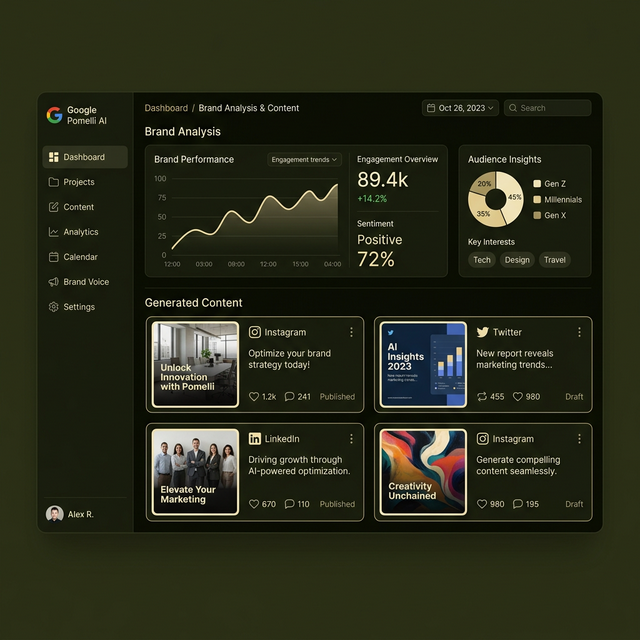
At its core, Google Pomelli is an AI-powered marketing assistant built specifically to help businesses create scalable, cross-channel, brand-aligned marketing campaigns in a fraction of the time it traditionally takes.
The fundamental problem with most generative AI tools today (like standard ChatGPT or Midjourney) is the "Frankenstein effect". If a small business owner tries to generate ten different social media posts using generic AI tools, each post will likely look and sound like it came from a completely different company. The tone shifts, the colors clash, and the visual identity becomes diluted.
Pomelli solves this massive friction point through context-aware generation. Instead of acting purely as a blank-canvas design tool, Pomelli positions itself as an automated marketing strategist. It eliminates the need for manual brand kit setups by leveraging Google's advanced language and vision models to analyze your existing digital footprint, learn your aesthetic, and enforce those rules across every single asset it creates.
2
The Core Architecture: The "Business DNA" Protocol
The true magic of Pomelli, and its biggest differentiator in the crowded SaaS market, is its Business DNA Builder.
Legacy design platforms like Canva or Adobe Express require you to manually input your brand's hex codes, upload specific font files, and drop in logo variations before you can even begin designing. Pomelli bypasses this tedious onboarding process entirely. The workflow relies on a website-to-brand pipeline.
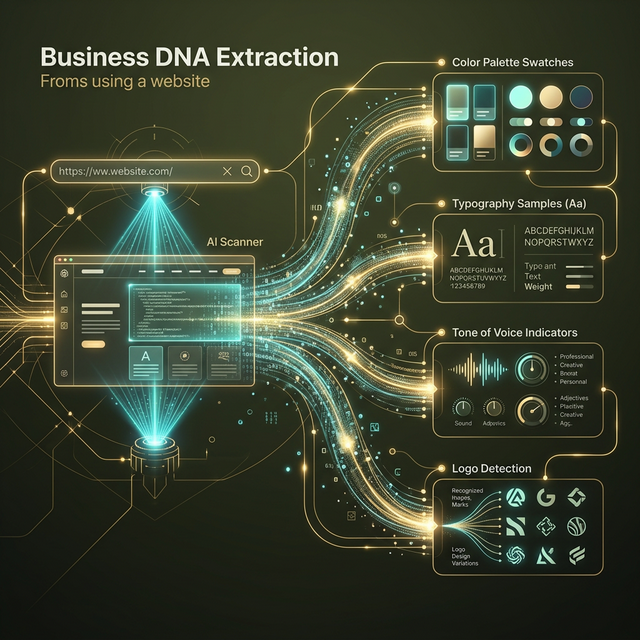
Here is exactly how the Business DNA extraction works:
The URL Scan
You simply paste your company's website URL into Pomelli.
Visual Identity Extraction
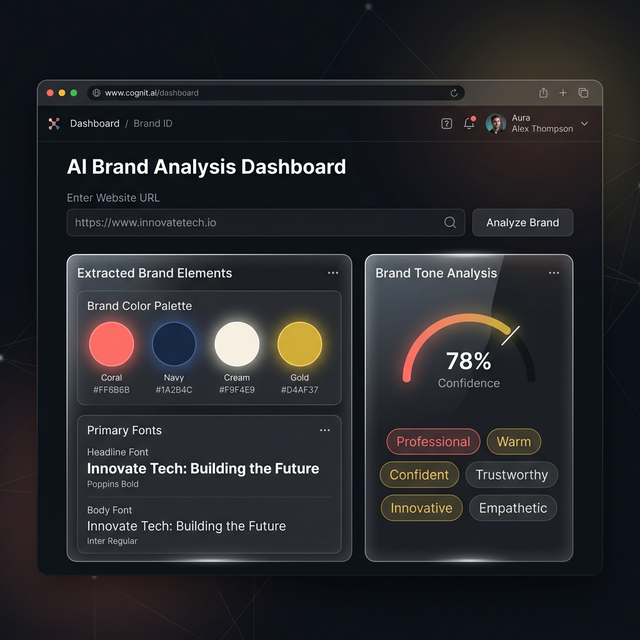
Within 30 to 90 seconds, Pomelli's computer vision models scan your public web pages. It identifies your primary, secondary, and accent color palettes (capturing exact hex codes), understands your logo placement, and maps out your visual layout patterns.
Typography Mapping
The system analyzes your CSS to identify your headline fonts, body text styles, and overall typographical hierarchy.
Linguistic Analysis
Using DeepMind's advanced Natural Language Processing (NLP), Pomelli reads your "About Us" page, service descriptions, and blogs to capture your exact tone of voice. It determines whether your brand is formal, playful, highly technical, warm, or luxurious.
Strategic Positioning
The AI extracts your core mission statements, unique selling propositions (USPs), and taglines.
The output of this rapid analysis is your "Business DNA"—a persistent, reusable vector profile that acts as a permanent, unbreakable style guide for the AI. From this point forward, every single image, caption, and video generated by Pomelli is anchored to this DNA, ensuring perfect consistency.
3
The 3-Step Campaign Workflow
Pomelli is designed to be exceptionally user-friendly, abstracting away complex design timelines and layers. The operational workflow shifts the human user's role from a "creator" to a "curator" and "assembler".
Step 1: Ideation and Strategy
Once your Business DNA is locked in, Pomelli shifts into campaign mode. Many marketers suffer from creative fatigue—staring at a blank screen wondering what to post this week. Pomelli acts as your brainstorming partner. Based on your industry and website offerings, the AI automatically suggests tailored marketing campaign themes (e.g., "Spring Skincare Launch," "Member Appreciation Week," or "B2B Tech Webinar"). You can select a suggested angle or input a custom text prompt for a specific goal.
Step 2: Asset Proliferation
Once a campaign direction is chosen, Pomelli goes to work. In roughly 60 seconds, the tool generates multiple cross-channel variations. It doesn't just create one image; it produces a complete package:
- Square (1:1) and portrait (4:5) posts for Instagram and Facebook.
- Vertical (9:16) graphics for Stories.
- Standard display banner sizes for Google Ads.
- Professional updates optimized for LinkedIn.
- Email newsletter headers and call-to-action (CTA) banners.

Step 3: Natural Language Editing
If an asset isn't quite perfect, you don't need to manually drag elements around. Pomelli features conversational editing. You can click on a generated post and type instructions like "Make the tone more premium," "Highlight our sustainability efforts," or "Change the background to a minimalist office". The AI instantly regenerates the asset based on your text commands.
4
Flagship Features: Photoshoot and Cinematic Animate
In late 2025 and early 2026, Google introduced two massive updates to the Pomelli ecosystem that transformed it from a simple graphic generator into a high-end production studio.
Photoshoot 2.0 Powered by Nano Banana
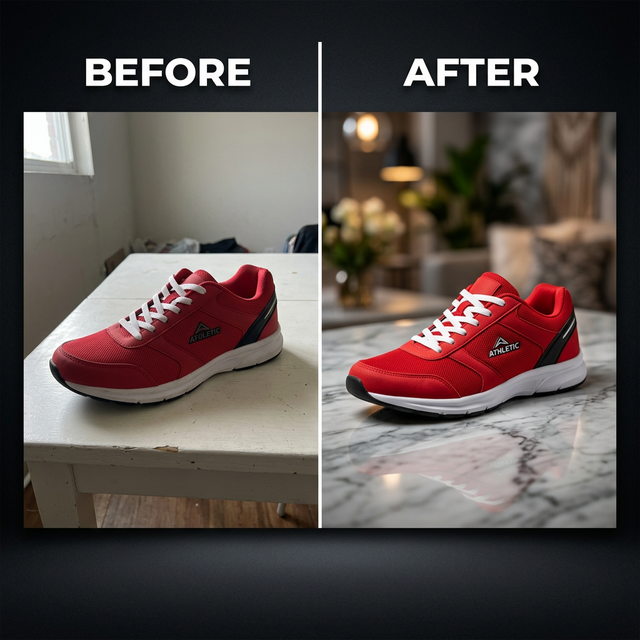
Product photography is arguably the biggest, most expensive bottleneck for e-commerce brands. A single professional studio shoot can easily cost between $500 and $5,000 per month. Pomelli's Photoshoot feature completely eradicates this barrier.
Powered by Google's highly advanced Nano Banana 2 image generation model, Photoshoot allows you to upload a basic, messy, poorly-lit photo of your product taken with an ordinary smartphone.
- How it works: The AI analyzes the geometry, texture, and original lighting of your product.
- The Magic: It cleanly extracts the product and synthesizes entirely new, photorealistic lifestyle or studio backgrounds around it.
- The Result: Your basic photo is transformed into a high-end ad creative with perfect dynamic lighting, natural ground shadows, and crisp reflections.
Because it references your Business DNA, if your brand aesthetic is "dark, moody, and neon," the AI will place your product in that exact environment rather than a generic white studio. This allows e-commerce brands to generate dozens of lifestyle variations for A/B testing on Facebook Ads in minutes.
Cinematic Animation Powered by Veo 3.1
Static images are losing ground in a world dominated by short-form video algorithms. To address this, Google integrated its state-of-the-art Veo 3.1 video generation model directly into Pomelli via the Animate feature.
You can now take any static, Pomelli-generated image and bring it to life with a single click. Veo 3.1 adds realistic camera panning, parallax depth effects, physics simulations (like steam rising from coffee or fabric blowing in the wind), and even synchronized ambient audio.
- Specs: It outputs high-definition 720p and 1080p cinematic videos ranging from 8 seconds up to an incredible 148 seconds.
- Impact: Marketers no longer need to rely on expensive video editors, After Effects, or complex keyframing. You simply design the static ad, hit 'Animate', and watch as a stunning motion-video ad is produced for your Instagram Reels or TikTok.
5
Google Pomelli vs. The SaaS Competition
To truly understand Pomelli's value, we must compare it to the current titans of the marketing software industry.
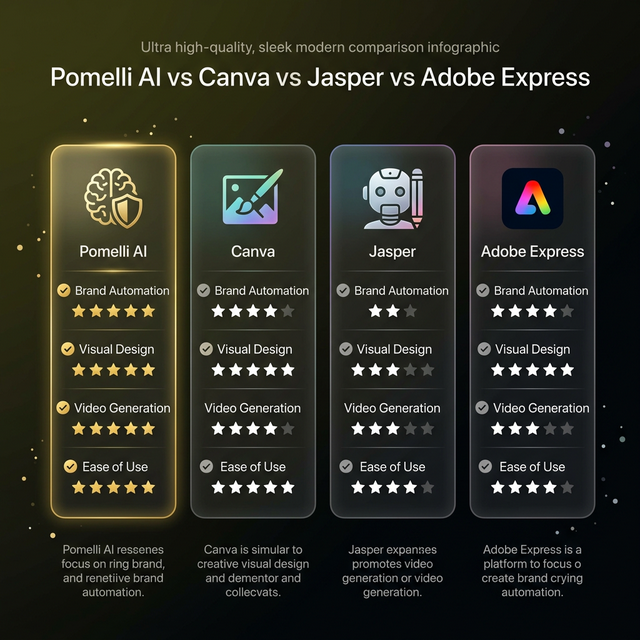
Pomelli AI vs. Canva
Canva is the undisputed king of accessible visual design, boasting over 100 million assets and massive template libraries. However, Canva is fundamentally a template-driven, manual tool. While Canva offers "Magic" AI features, you still have to manually construct your Brand Kit, drag and drop elements, and apply your branding post-by-post.
The Verdict: Pomelli is an automation-first tool. It starts with your brand DNA and builds content around your identity instantly. Early tests show that Pomelli is 30% to 40% faster than Canva at generating a publishable first draft of a multi-platform campaign. Canva wins on deep manual layout control; Pomelli wins on speed and automated brand enforcement.
Pomelli AI vs. Jasper
Jasper AI evolved into a highly sophisticated enterprise copywriting platform, excellent for long-form blog posts and maintaining strict corporate brand voices.
The Verdict: While Jasper dominates text pipelines, its visual capabilities are secondary. Pomelli provides the perfect hybrid: it produces solid, brand-aligned copy while simultaneously handling complex visual design and video generation. For pure writing, choose Jasper. For end-to-end social media and ad visuals, Pomelli is superior.
Pomelli AI vs. Adobe Express
Adobe Express leverages Adobe Firefly to create stunning, high-fidelity generative imagery. It integrates seamlessly into the broader Creative Cloud ecosystem.
The Verdict: Adobe Express has a steeper learning curve and is geared towards those who want professional-grade graphic design editing. Pomelli focuses on frictionless execution for non-designers. If you want pixel-perfect, layer-based control, use Adobe. If you want an entire month's worth of branded ad creatives in ten minutes, use Pomelli.
6
Real-World Applications and ROI
The economic and operational implications of Pomelli are massive for various business sectors:
🛒 E-Commerce Brands
Can launch a new product, run a single smartphone photo through the Photoshoot tool, and instantly generate 20+ ad variations for A/B testing on Meta Ads, all utilizing the same brand colors and typography.
🏪 Local Businesses (Restaurants, Gyms, Salons)
A local coffee shop can generate their weekly specials in minutes. Pomelli creates an Instagram Story, a Facebook post, and an email header that all look professionally designed, maintaining a cohesive local brand presence.
📊 Marketing Agencies & Freelancers
Agencies can use Pomelli to rapidly scale the "unscalable" routine content. By creating Business DNA profiles for 10 different clients, an agency can generate baseline social media calendars in hours instead of weeks, freeing up human designers to focus on high-level strategic work.
7
Current Limitations: The Catch
While Pomelli feels like magic, it is important to remember that it is currently a Google Labs Experiment in Public Beta. Marketers should be aware of a few realities before fully transitioning their workflow:
- No Direct Publishing or Scheduling: As of now, Pomelli is an asset generator, not a social media manager. You cannot link it to your Facebook or Instagram accounts to auto-publish. You must download the generated ZIP files and manually upload them or use a tool like Hootsuite/Buffer.
- Website Dependency: The AI is only as smart as the data you feed it. If your business website is outdated, lacks text, or has inconsistent branding, Pomelli's extracted "Business DNA" will be weak, resulting in generic outputs.
- Language Restrictions: Officially, the tool currently only supports English language inputs and outputs.
- "Safe" Aesthetics: Because AI models aim for mathematical optimization, Pomelli sometimes leans towards a "safe, corporate, median" aesthetic. Highly niche, artistic, or avant-garde luxury brands might find the outputs slightly too "template-y" and will still require a human art director's touch.
8
The Future: A Centralized Marketing Ecosystem
What makes Pomelli truly exciting is where it is heading. Because it is built by Google, industry analysts expect deep, native integrations with the broader Google ecosystem by late 2026.
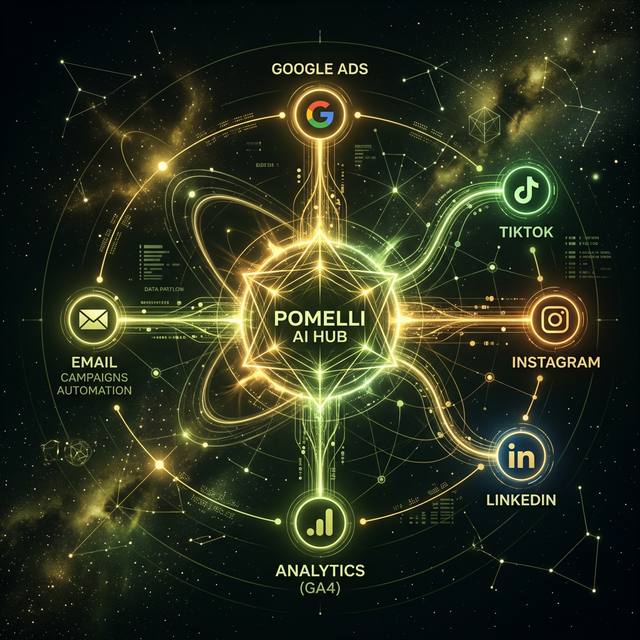
Imagine a near-future workflow where you generate an entire campaign in Pomelli, and with one click, it pushes those assets directly into Google Ads Manager. The system could automatically attach UTM tracking tags, monitor performance in GA4, and use real-time data to autonomously tweak the Business DNA and generate better-performing visuals for the next week's campaign.
Conclusion
Google Pomelli is permanently lowering the barrier to entry for high-quality, professional marketing. It proves that the future of AI in marketing is not just about generating random images from prompts, but about contextual, brand-aware automation.
While it won't entirely replace the strategic mind of a seasoned marketer or the detailed eye of a senior designer, it serves as the ultimate "Creative Co-Pilot". By handling the tedious mechanics of brand enforcement, layout formatting, and cross-channel resizing, Pomelli gives small business owners their most valuable asset back: Time.
Ready to test it for your brand? Head over to labs.google.com/pomelli, paste your website URL, and watch your brand's Business DNA come to life.